Your Guide to AIP Food Reintroductions: Timing, Foods, and Symptom Monitoring
Reintroducing foods after the AIP elimination phase is a powerful step toward building a personalized, sustainable diet that supports your autoimmune health. This phase helps you identify food triggers, expand your nutrition, and regain flexibility, all without compromising the progress you have made so far.
NOTE: This is my interpretation and understanding of the Autoimmune Protocol (AIP). Nothing in this blog is medical advice. What works for me, might not work for you. Consult a professional before embarking on this restrictive diet. But perhaps, by sharing experiences we can learn from each other. Read my full disclaimer.
What is the AIP Reintroduction Phase?
Once you have followed the AIP diet (core or modified AIP) for a few weeks, and you have noticed some improvements in your symtpoms, it is time to reintroduce some foods!
This is a very important part of the Autoimune Protocol and the healing journey. This is where you develop your own persomalized diet, figure out what works for you and what triggers some symtpoms!
It is important to reintroduce foods! The elimination diet is very restrictive, and it can be really hard staying on it for a long time! I don’t think it is sustainable for the long term!
When Should You Start your AIP Reintroductions?
Most people begin reintroductions after 30 to 90 days of consistent elimination, once they’ve seen measurable improvements in symptoms, energy, digestion, sleep, or lab markers. If you’ve reached 90 days and haven’t seen progress, it may be time to troubleshoot with a practitioner before moving forward.
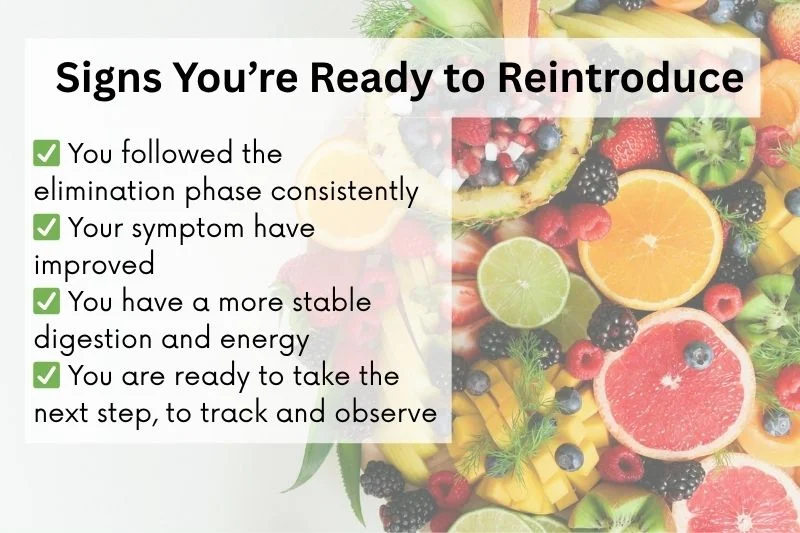
You’re ready to reintroduce foods when:
- You’ve followed the elimination phase consistently for some time
- You’ve experienced noticeable symptom improvement. Not all symptoms need to have disappeared, but you should have felt some alleviation!
- You feel stable and resilient enough to track changes
- Your lab markers show signs of improvement (BUT: not everyone sees improvement with diet alone)
How to Reintroduce Foods Step-by-Step
The Reitroduction phase is further divided into 4 stages. Each stage contains a group of foods. Once you have reintroduced all the foods you would like to reintroduce from the first stage, you move on to the second stage.
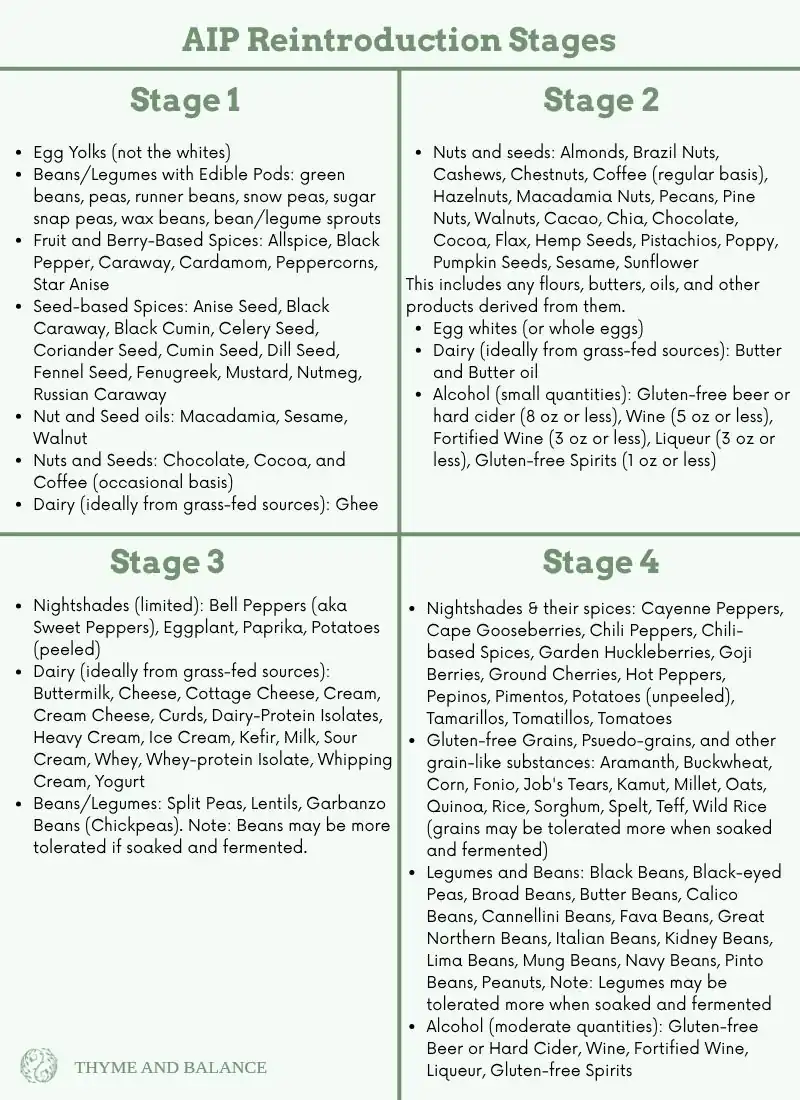
Of course you don’t have to reintroduce all foods! If there is something you don’t like, or know that does not agree with you, just skip it.
The recommended way is to take the food you want to reintroduce. Eat a little bit, and see if you notice anything different, a few minutes later you can have a little bit more and wait a few hours.
If you have no reactions you can have a normal portion of the food.
It at any point you have any reaction or think you might have symptoms reappear. Write it down and stop. You can try this food again at a later stage, but your bosy either does not like it, or you need more time to heal before successfully reintroducing it.
Most people recommend to wait about 7 days before reintroducing a new food. Some say shorter (no shorter than 3 days though), but I feel like the body sometime takes a bit longer to react, so I like to leave a longer gap! Slow and steady!
I also sometimes reitroduce a food, don’t eat it for a two weeks or more and then try again. Just to make sure. My symptoms can be very subtle, so I like to be extra careful and pay double attention!
And then, on accasion something happens, and you might have to go back to AIP for a few days/weeks. Reintroductions can be quicker the next time round. But it can also be that foods you were OK with before, are not OK now. Who knows why. It can be really frustrating!
It’s not a linear process! And it really tests our patience!! But please please please take your time with it! It is so worth it! I made the mistake of not tracking symptoms properly. And at some point I just gave up and started reintroducing foods too quickly.
I ended up with a really bad flare-up and took another round of Core AIP with very difficult reintroductions. And I am still reintroducing, little by little.

Core AIP vs. Modified AIP Reintroductions
The reintroduction process differs slightly depending on which elimination phase you followed. When on the Modified AIP, you are already eating some of the foods that are excluded from the Core AIP diet, so that makes reintroductions a little bit faster and easier.
Core AIP Reintroduction starts from the more restrictive baseline and you likely have more foods you would like to reintroduce. Foods are reintroduced in four stages. The first stage begins with the most nutrient-dense foods and least likely to cause a reaction. Examples include egg yolks, ghee, and some seed-based spices. And then it moves to more inflammatory or complex foods (like nightshades, legumes, and grains).
Modified AIP Reintroduction begins with a broader base, since some foods like white rice, ghee, and legumes may have already been included. Reintroductions here focus on expanding with a similar goal to the Core AIP diet. Start with nutrient-dense foods such as eggs, gluten-free grains, and additional nightshades. The process is still slow and intentional, but the starting point is less restrictive.
Both approaches aim to help you build a personalized diet that supports your long-term health. The key difference is where you begin and how many foods you need to test.
Why Reintroductions Matter
The elimination phase of the Autoimmune Protocol is not meant to last forever! Staying on a restricive diet like this for too long can lead to nutrient gaps, social isolation, and unnecessary stress. Reintroductions help you:
- Discover your personal food triggers
- Expand your diet for better nutrition and variety
- Improve the enjoyment of your meals
- Support mental and emotional well-being
- And it makes it more sustainable to follow a diet that is not too limiting!
Reintroducing foods also helps you tune into your body’s signals and build confidence in managing your autoimmune condition long-term. It teaches you to listen to your body and pick up on signals when something does not agree with you!
I have learnt so much about myself and how my body responds through reintroducing various foods!
Final Thoughts
The AIP Reintroduction Phase is where healing becomes personal. It’s not just about what you eliminate—it’s about what you reclaim. By listening to your body, tracking your symptoms, and moving slowly, you can build a diet that supports your autoimmune health while giving you the freedom to enjoy food again.
Whether you’re coming from Core AIP or Modified AIP, this phase is your opportunity to create a sustainable, nourishing lifestyle that works for you. Not just for now, but for the long haul!
I’d love to hear about your experience! Whether you’re just getting started or have been on the protocol for a while, your story can help others feel supported and inspired.
Drop a comment below to share your thoughts, tips, or questions! Or let me know what part of the AIP journey you’d like me to write about next. And if you found this post helpful, feel free to share it or connect with me on Instagram or send me an email. Let’s support each other on this healing path.